
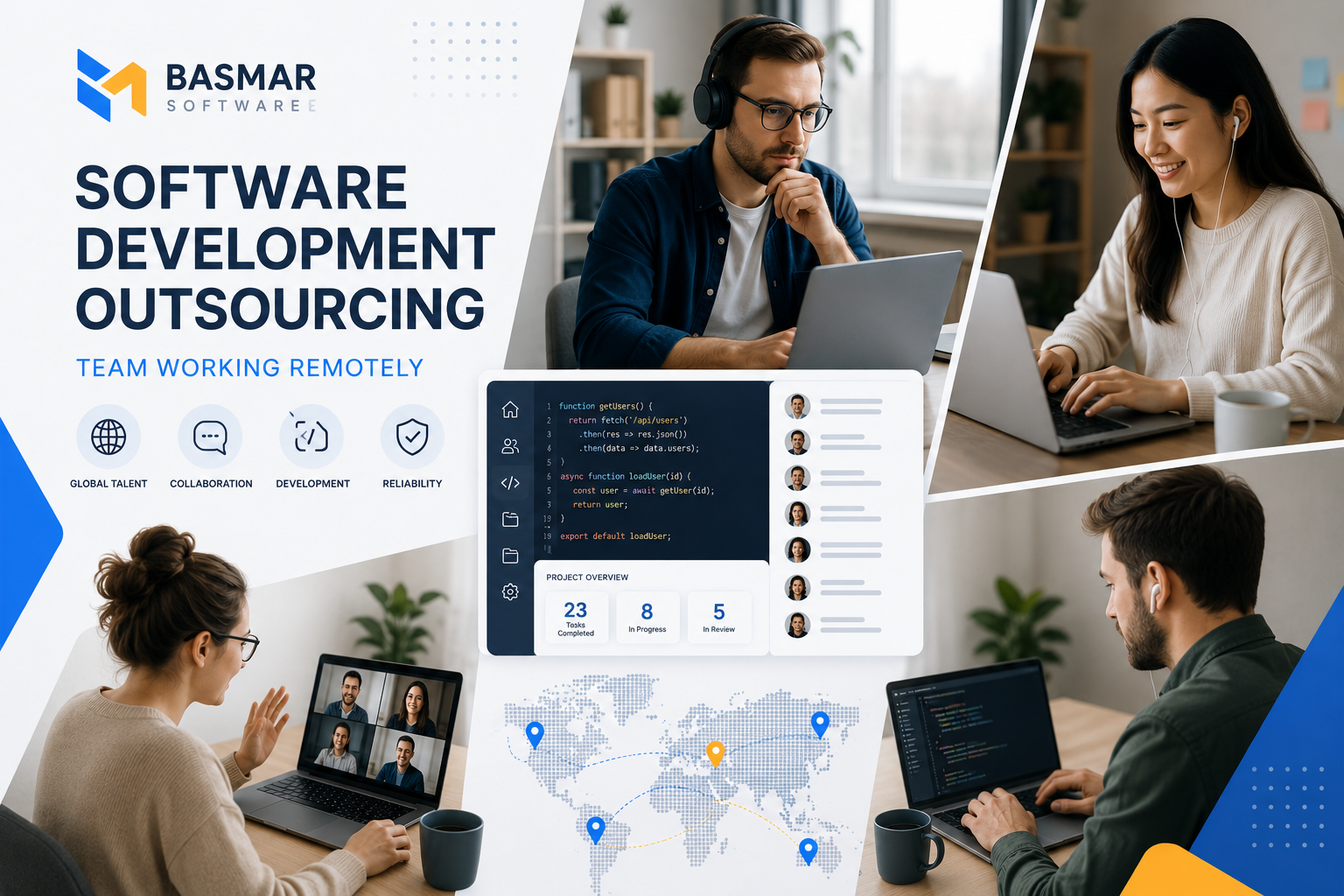
Software development outsourcing is the practice of hiring an external team — in another city, country, or region — to build, maintain, or scale your software product instead of doing it entirely in-house. For founders and CEOs running lean organizations, it’s one of the fastest ways to access senior engineering talent without the overhead of full-time hiring.
The numbers reflect the shift: 70% of companies that outsource cite cost-effectiveness as the primary driver, and the IT sector routes more than a third of its operations through external partners, allocating an average of 13.6% of IT budgets to outsourcing.
But the model only works when you choose the right partner. The market is crowded, vendor websites all sound confident, and the gap between a team that delivers and one that doesn’t isn’t visible until you’re already mid-project. This guide covers what actually matters when evaluating a software development outsourcing partner — and what gets underestimated most often.
Define Your Requirements Before You Talk to Anyone
The single most common reason outsourcing engagements underdeliver isn’t vendor quality — it’s unclear requirements. Before evaluating any partner, get specific about what you’re outsourcing, what expertise level you need, what your budget ceiling is, and what a successful outcome actually looks like.
No outsourcing team, regardless of experience, can compensate for a client who hasn’t decided what they’re building. The specificity of your brief directly determines the quality of what comes back. Define scope, constraints, and success criteria first — then start the search.
Understand the Three Outsourcing Models
Software development outsourcing comes in three geographic structures, each with different cost and collaboration trade-offs:
Onshore outsourcing — the vendor operates in your country or region. Easiest timezone overlap and cultural alignment, highest cost, more limited talent pool.
Nearshore outsourcing — the vendor is in a neighboring country or similar timezone. Strong balance of collaboration quality, talent access, and cost. Eastern European teams working with Western clients are a common example.
Offshore outsourcing — the vendor is in a different region with significant timezone difference. Maximum cost advantage and the widest global talent pool, but requires deliberate communication structure to work well.
None of these is universally better. The right model depends on how hands-on you need to be day-to-day and how much timezone overlap your workflow requires.
Where to Find Credible Outsourcing Candidates
Once you know what you’re looking for, the practical question is where to look:
Clutch and similar platforms list verified vendors with structured client reviews — harder to manipulate than testimonials on a vendor’s own site. Filter by industry, service type, and company size to narrow the field.
Referrals from your network are the highest-signal source. If someone you trust has worked with a team and would hire them again, that recommendation is worth more than any case study.
Targeted search using specific keywords tied to your stack or industry surfaces teams with relevant specialization rather than generalists.
Industry events and professional communities are useful for finding teams with genuine domain expertise in your sector.
Start with a longer list, apply the criteria below, and narrow to two or three finalists before making any commitments.
What to Evaluate When Assessing a Vendor
Technical Depth and Relevant Domain Experience
Generic development skill is table stakes. What actually differentiates vendors is relevant experience — teams that have built products in your industry understand the constraints, edge cases, and compliance requirements that a generalist team will discover slowly and expensively.
Ask for examples of similar projects. Ask what went wrong and how they handled it. Ask about their technology choices and whether they reflect current practice or institutional habit. How a team discusses past failures tells you more than how they describe their successes.
Data Security and IP Protection
You’re handing an external team access to your codebase, product logic, and potentially customer data. Ask specifically about internal access controls, data handling protocols, what happens to your IP after the engagement ends, and whether they carry relevant security certifications.
Get an NDA in place before any substantive product conversation. This should be immediate and standard — any hesitation is a signal worth noting.
Communication Structure and Responsiveness
Most outsourcing relationships break down on communication, not technical capability. A team that goes quiet between sprints, gives vague status updates, or surfaces problems only after they’ve become crises will cost you more than a more expensive team with a cleaner process.
Evaluate communication during the sales process itself — it’s a live preview of how they’ll operate. Are they responsive? Do they ask sharp questions? Do they push back when something doesn’t make sense, or do they agree with everything? Unconditional agreement is a warning sign.
Establish expectations before work begins: which channels, update cadence, escalation paths, and how timezone differences will be managed. These things are all solvable — but only if you structure them deliberately.
Cultural Fit and Shared Work Ethic
Underestimated until it becomes the problem. A team that shares your standards around quality, ownership, and pace will integrate into your product process in a way that a technically capable but culturally misaligned team never will.
Ask how they handle disagreements with clients. Ask what happens when they believe the client’s direction is technically wrong. A team that will tell you the truth when it matters is worth significantly more than one that optimizes for keeping the relationship comfortable.
Scalability and Long-Term Flexibility
Your requirements today are not your requirements in eighteen months. Evaluate whether the vendor can grow the engagement — adding specialists, expanding into adjacent areas, increasing velocity — without you having to start over with someone new.
Ask about their capacity, their largest engagements, and how they handle scope changes mid-project. The goal is a long-term partner, not a transactional vendor relationship that creates dependency without flexibility.
Agile Delivery Process
In fast-moving product environments, a rigid delivery process creates friction at every change in direction. Ask what Agile actually means in their workflow — sprint structure, how requirement changes are incorporated, how priorities get re-evaluated between cycles.
The word gets used loosely. What you want is a team that can explain their process clearly, adapt it to your context, and demonstrate that it produces consistent, predictable output.
Quality Assurance and Service Level Agreements
The software your outsourcing partner ships is your product to your customers. QA is not a phase at the end of development — it’s a structural part of the engagement. Ask whether testing is integrated throughout the development cycle or bolted on at the end. Ask whether they have dedicated QA engineers or whether developers test their own work.
Service Level Agreements formalize what “good” means and create accountability when it isn’t delivered. Any serious vendor will define SLAs clearly and commit to them contractually.
The Real Cost of Choosing the Wrong Vendor
The risks of a poor vendor selection aren’t abstract. They show up as a product that doesn’t match what you specified, code quality that generates long-term technical debt, security vulnerabilities that weren’t caught, timelines that slip past your funding or launch milestones, or — in the worst cases — a vendor that goes dark mid-project and leaves you with a partially built product and no clear path forward.
Switching vendors mid-project is possible but expensive. A new team needs time to understand an unfamiliar codebase, and that time costs money and momentum. The cost of getting the first decision right is a fraction of the cost of recovering from the wrong one.
The mitigation is straightforward: invest the time upfront. Check references directly. Run a small paid pilot before committing to full scope. Read contracts carefully. Define success criteria before work begins, not after it ends.
Working With Basmar Software
At Basmar Software, we work with founders and product teams who need a technical partner they can rely on — not one that oversells and underdelivers.
Our process is built around clear communication, structured delivery, and engineering quality that doesn’t get traded away under deadline pressure. We ask hard questions at the start because surfacing a wrong assumption in week one costs far less than delivering the wrong thing in month five.
If you’re evaluating software development outsourcing options and want a direct conversation about fit — we’ll give you an honest assessment, not a sales pitch.
Get in touch with the Basmar team →
Frequently Asked Questions About Software Development Outsourcing
What is software development outsourcing? Software development outsourcing is the practice of hiring an external company or team to handle part or all of your software development work — including building new products, maintaining existing systems, or scaling engineering capacity — instead of relying solely on in-house staff.
What are the main types of software development outsourcing? There are three primary models: onshore (vendor in the same country), nearshore (vendor in a neighboring country or similar timezone), and offshore (vendor in a different region with significant timezone difference). Each offers different trade-offs in cost, collaboration quality, and talent access.
How do I evaluate a software development outsourcing partner? Key evaluation criteria include: relevant domain experience, technical depth in your stack, data security protocols, communication structure, cultural alignment, scalability, delivery methodology, and QA practices. Referrals from trusted sources and verified reviews on platforms like Clutch are the most reliable signals.
What are the biggest risks of outsourcing software development? The most common risks are misaligned requirements, poor communication, inadequate QA, data security vulnerabilities, and vendor reliability. These are mitigated through clear scoping, structured contracts, NDAs, SLAs, and starting with a smaller pilot engagement before committing to full project scope.
Is software development outsourcing suitable for startups? Yes — outsourcing is particularly well-suited for startups that need to move fast without the overhead of building a full in-house team. It provides immediate access to senior expertise, reduces hiring and onboarding time, and allows the team to scale up or down based on project phase.
What should a software development outsourcing contract include? A solid outsourcing contract should cover scope of work, delivery milestones, IP ownership, data security obligations, NDA terms, Service Level Agreements, escalation procedures, and terms for ending the engagement if needed.
How much does software development outsourcing cost? Cost varies significantly based on the engagement model, team location, seniority level, and project scope. Eastern European outsourcing teams typically offer competitive rates with strong engineering quality. Nearshore and offshore models generally cost less than onshore equivalents for comparable skill levels.